
Arkansas City Directory Year Runs
Arkansas has no single statewide shelf for local name-and-address books. The surviving volumes sit across the Library of Congress (LOC), St. Louis County Library (SLCL), FamilySearch, and state or county archives. The SLCL Arkansas inventory is a useful starting point because it lists towns and individual years. Little Rock has the longest set in the inspected catalogs, while Fayetteville, Hot Springs, Jonesboro, and Pine Bluff have selected years. Treat those entries as a map to a volume, not proof that the full run is digitized.
| Arkansas collection | Verified years | Where held | How to reach it |
|---|---|---|---|
| Little Rock name-and-address volumes | 1871-1917 in scattered runs; 1919-20 through 1934-35 in selected runs; 1962 sample | LOC, SLCL, Google Books, research libraries | Search catalogs; confirm format and gaps |
| Fayetteville name-and-address volumes | 1939, 1947, 1951, 1955, 1957 | SLCL inventory; check Fayetteville shelves | Catalog lookup, library visit, or staff inquiry |
| Greater Little Rock phone books | January 1936-July 1939 | LOC digitized item and microfilm | Open the item record and browse pages |
| Hot Springs, Jonesboro, Pine Bluff | Selected runs, 1908-1960 | SLCL and other research libraries | Use the town-by-town inventory |
| Arkansas gazetteers and business books | 1906-07 and 1912-13 | SLCL print or microfilm inventory | Request the specific volume or reel |
Catalog gaps matter. Little Rock's 1962 R.L. Polk & Co. directory is a visible sample, but the inspected sources do not verify a complete Little Rock run or a final publication year. The Fayetteville years are also snapshots, not annual coverage. Ask the holding library whether a missing year is absent, held under a neighboring city name, or available only on microfilm. For a statewide question, start with the right county and city, then follow the catalog to its actual keeper.
Little Rock's Arkansas Directory Shelves
For Little Rock, LOC and SLCL list volumes from the 1870s onward, but with breaks: LOC/SLCL inventories include 1871-74, 1876-78, 1880-84, 1886-87, 1890, 1893-1904, 1906-08, and 1910-17, followed by several later runs. A separate combined Little Rock/North Little Rock series lists 1937, 1939-40, 1942, 1944-45, 1947-49, 1951, 1953-54, and 1956-59. The inspected list does not establish that each year survives or is online. Note the exact city label in a catalog record, since Little Rock and North Little Rock may be combined in one volume.
The LOC record for Greater Little Rock white and yellow pages covers January 1936 through July 1939. Telephone pages can add a phone number or business listing when a family name is already known, but a listing is not a full household census. The pages can be browsed online or sought on microfilm through a research library. A digitized item may be easier to open from its record page than through a broad search for an individual's name.
The SLCL year-run inventory shown below points to Arkansas directory holdings. Check the listed year and town before planning a visit or a remote request. A catalog record names a holding; it does not promise a complete scanned book.
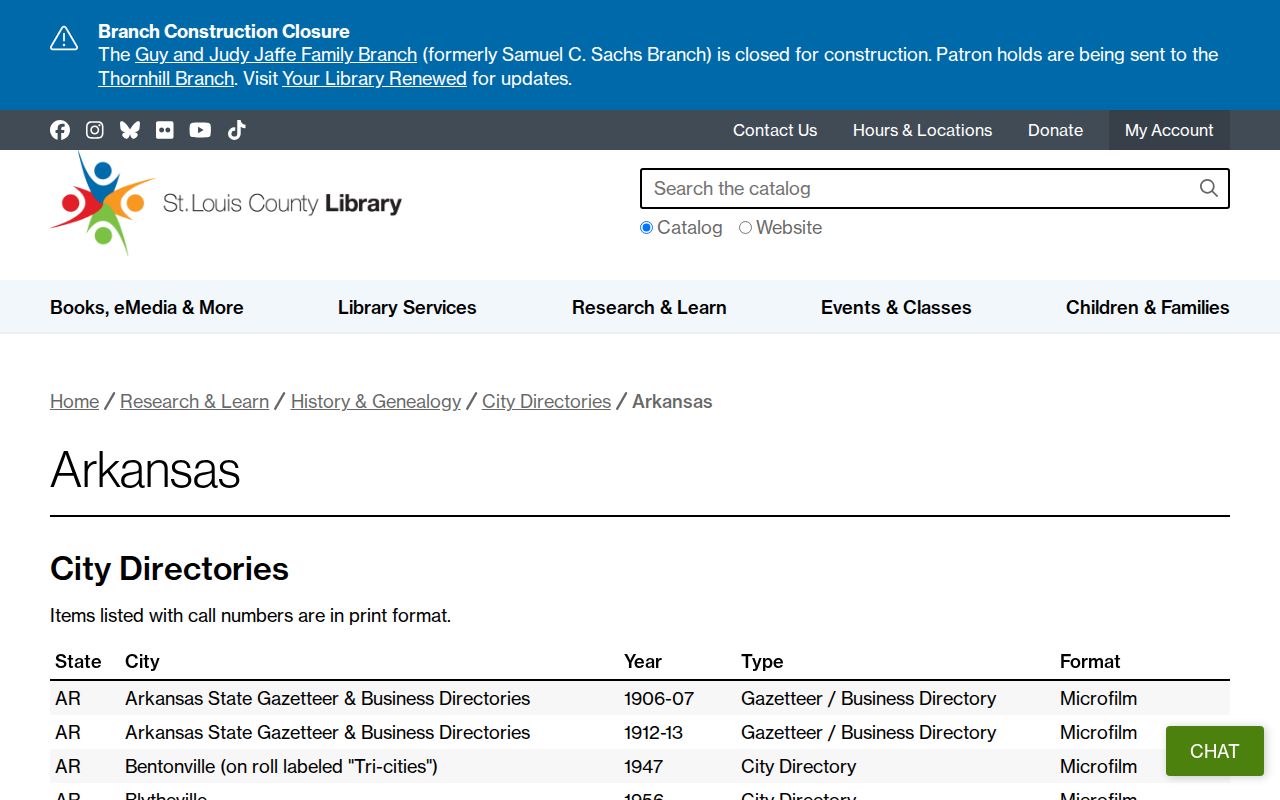
Compare the town, year, publisher, and format in the record before treating a gap as a missing local history source.
Arkansas City Directories Beyond Little Rock
Fayetteville has verified city-directory years for 1939, 1947, 1951, 1955, and 1957 in the SLCL inventory. Hot Springs has selected entries from 1912 through 1957-58, Jonesboro from 1936 through 1959, and Pine Bluff from 1908 through 1960. These dates identify cataloged examples, not an unbroken annual sequence. Search nearby library catalogs as well as the town name, because a directory can be held outside the city it covers.
Fayetteville Public Library's Grace Keith Genealogy Collection adds microfilm, county books, maps, newspapers, yearbooks, cemetery material, and vertical files. Its county guide gives useful start dates for Washington County: land from 1834, probate from 1830, court from 1835, marriage from 1845, and birth and death from 1914. Those start dates tell researchers where to look, not whether every item survived or can be searched online. Ask staff about the relevant county book or reel before making a trip.
The Fayetteville library is at 401 W Mountain Street. The genealogy desk lists 479-856-7253 and genealogy@faylib.org; its posted hours are Monday through Thursday, 9 a.m. to 8 p.m., Friday and Saturday, 9 a.m. to 5 p.m., and Sunday, 1 p.m. to 5 p.m. Staff can check a shelf or microfilm reader in person and respond to research requests. Copying or research may incur a charge, but the reviewed page does not set a single current fee.
Other local books also include gazetteers and business directories. SLCL lists Arkansas state gazetteers for 1906-07 and 1912-13. These can place a business or professional name in a period when a local volume is missing, but the statewide business listing is not a substitute for a named household entry. Keep the source type beside each note so a company listing is not mistaken for a resident listing.
Reading an Arkansas Polk Entry
A Little Rock R.L. Polk volume shows why the index and abbreviation key belong beside every transcription. In the inspected 1962 sample, the contents include a general index and local forms such as LR and NLR, shortened road or avenue names, and numbered streets. A typical entry may give a person's name, a spouse or household notation, occupation, business, street address, and sometimes a telephone number. The exact fields vary by publisher and by book. Copy the heading and the printed mark as it appears, then use that volume's own key to read it.
| Name line | Listed person's name; spouse or household notes may follow in parentheses |
|---|---|
| Occupation or business | Historical description printed for that edition; abbreviations need the book's key |
| Street address | House number and street wording as printed, including direction and city shorthand |
| Household mark | Some books note owner, renter, widow, or boarder status; meanings vary by volume |
| Telephone entry | A phone number may appear in a telephone directory, not every local volume |
- Criss-cross directory
- A reverse list arranged by street address, so a known number can lead to a listed name.
- Householder index
- An alphabetical name list that points to a page or street entry in the volume.
- Abbreviation key
- The publisher's list of shortened words and local forms. Check it before expanding any street or status mark.
The Google Books record for the 1962 volume exposes title and contents information, but not a text-recovered sample name or a full abbreviation key. Do not supply a meaning from memory when the book's scan or a librarian can confirm it. A directory entry records what the publisher listed for that edition. It is historical evidence, not proof that the person lives at that address now.
Arkansas Criss-Cross Directory Years
A criss-cross directory reverses the usual name-first lookup. It is useful when a family address survives but the occupant's name is uncertain. LOC's guide lists Little Rock/North Little Rock volumes for 1960, 1961, 1964-1985, 1986-95, and 1990-96; the overlapping spans and gaps mean the guide should be read as separate catalog entries, not a claim of annual coverage. For Northwest Arkansas, the verified reverse-directory years are 1937 and 1970-1993. Libraries may hold print or microfilm copies even when a page is not digitized.
Use the LOC criss-cross guide to identify the city and edition, then check a library catalog or contact its reference desk about access. The image below shows the guide's Arkansas holdings. A reverse lookup gives a name associated with an address in that edition; compare it with the alphabetical city-directory section and other records before tying it to a family.
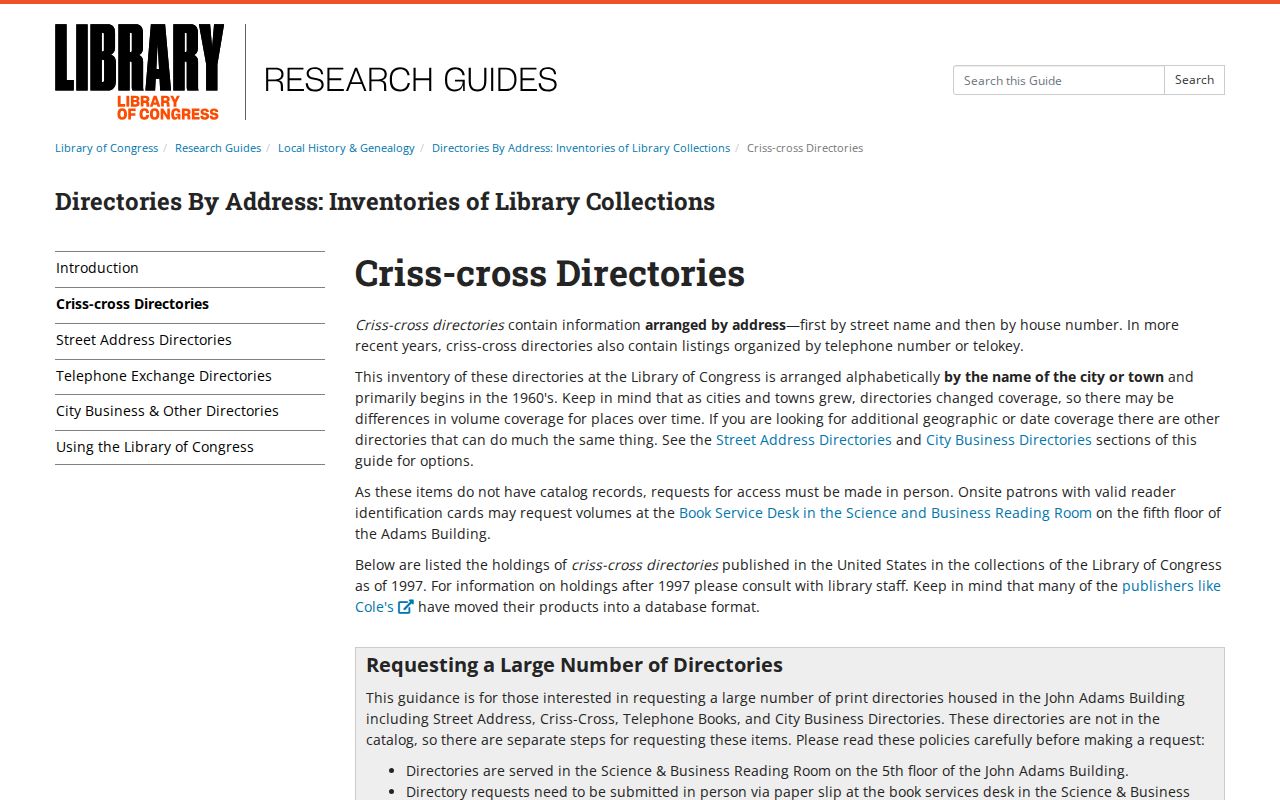
That distinction is valuable when researching an old address: the reverse section finds a possible name, while the name section helps test a spelling or household link.
Digitized Arkansas Directory Records
FamilySearch's US City and Business Directories collection spans about 1749-1990 and indexes names, places, and businesses. Its keyword search can include a street address, religion, occupation, place or person, and marital status; the search form also offers name, location, type, batch, and film or digital group number fields. Some images may require an account or affiliate access. Search spelling variants and a nearby city name, then open the image or catalog detail to confirm the printed source and year.
The Arkansas Digital Archives is a separate state collection for government and county records, not a complete city-directory shelf. It includes territorial, county, court, land, tax, marriage, military, and other government material. Its own collection notes say most county records and newspapers are not digitized, so an online search can return only part of the trail. The government collection shown below is one starting point for county and state material that can support a directory find.
The Arkansas Digital Archives government collection shown below gives online access to selected digitized records. When the result list stops short, the Arkansas State Archives research room and email copy service, county archives, library microfilm, and local reference staff remain useful paths. Staff determine the page count and copy price for requests; payment to the State Archives is by check, money order, or cash, with no card payment.
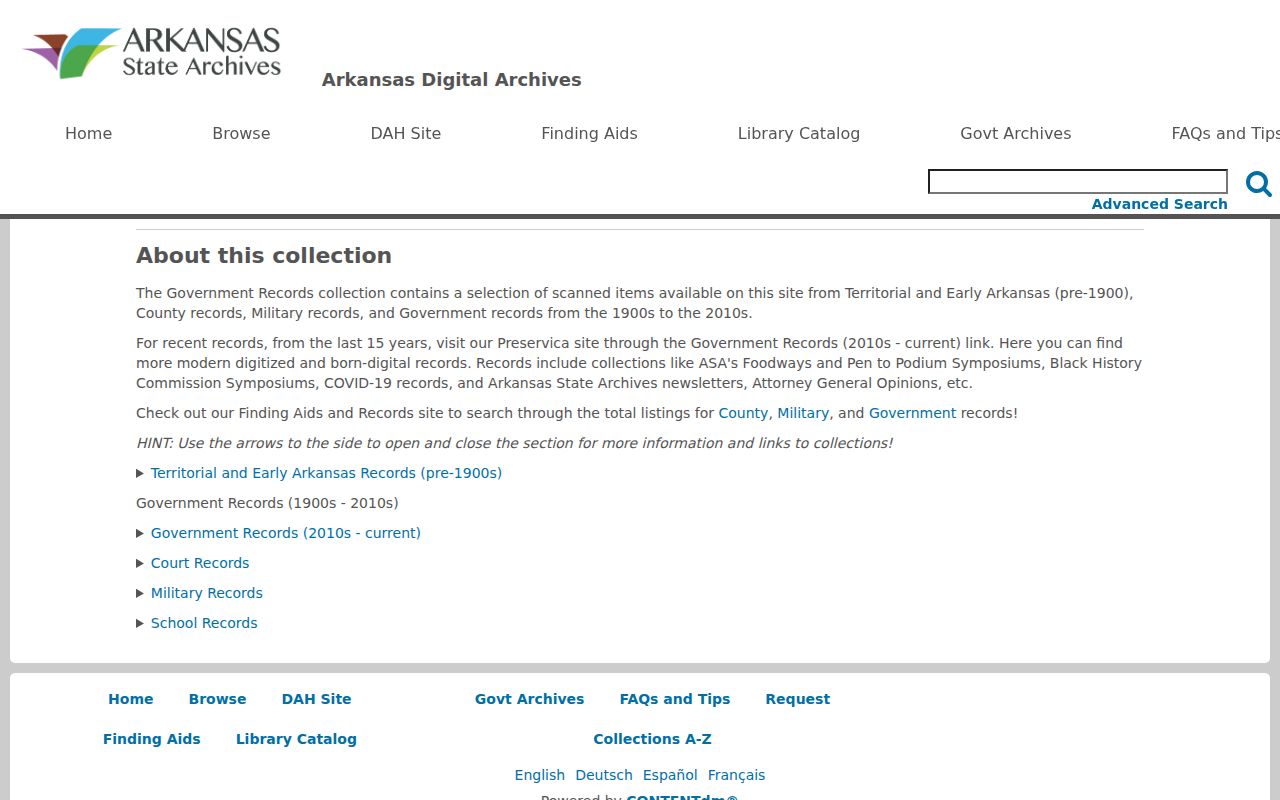
Use the online collection to locate a record group, then ask the holding archive about microfilm, an email scan, or an in-person visit when the item itself is not digitized.
Match Arkansas Directory Years to Census
One directory year can anchor a family story, but the best results come from comparing sources that were made for different reasons. Fayetteville Public Library lists census microfilm from 1830-1940 alongside local and county books, maps, yearbooks, newspapers, and obituary resources. Federal census schedules are released after a 72-year wait. A census can show a household at a broad point in time; the printed book can add a street or business listing in a nearby year. Neither source guarantees that every person at an address was listed.
- Write down the person's full name, town, and the directory year, along with the page or volume that supports it.
- Check the next available edition and note each street change, spelling change, and household mark.
- When only an address is known, use a criss-cross volume for the closest available year, then check the name section.
- Pair the directory with the nearest released census year and compare household members, age ranges, and place.
- Use local newspapers, obituaries, cemetery books, probate, or yearbooks to test a move, death, or family link.
Fayetteville's Grace Keith collection has newspapers ranging from the Fayetteville Witness (1841) through the Northwest Democrat Gazette (2015-present), plus Arkansas Gazette runs including 1828 and 1865-1947. Its onsite resources include obituary material and licensed databases. A name disappearing from a directory alone does not tell why: the person may have moved, the book may have skipped a year, the publisher may have changed its coverage, or the listing may have been omitted. Look for a second source before deciding what happened.
For family history, keep a small source log with the exact edition, page, address as printed, and any modern interpretation in separate fields. That makes it easier to spot a surname variant or a street abbreviation without silently changing the original. The book is most useful when its limits stay attached to the result.
Why Arkansas Directory Runs Have Gaps
Arkansas records have uneven survival. The State Archives reports that roughly 40 of the state's 75 counties experienced a courthouse fire, tornado, or flood that destroyed some early records. That figure is a reminder to check more than a county web index. The Archives holds microfilmed marriage, probate, tax, land, and court records from all 75 counties, and its catalog can be searched by title, name, record type, and place. Staff also answer email requests and can arrange scans or copies after assessing the item.
Some unusual census substitutes add a local thread when standard sources are thin: Arkansas' 1829 Sheriff's Census, an 1865 Washington County census, and an 1887 Newport census. These are not substitutes for an annual directory volume, but they can connect people to a place before or between surviving runs. Newspapers, tax records, cemetery books, church registers, and manuscript collections may help explain a gap. The State Archives research information explains the statewide microfilm route; ask the local library or archive which records cover the county and period in question.
Directories are snapshots, while the archival record is shaped by what each county kept, what survived, and what has been scanned. Keep the town, county, date, and holding institution with every result so that a record from one Arkansas city is not mistaken for a statewide listing.