
Arkansas Resident Lookup Records
Arkansas has no single public file that proves a named person lives at an address. County and state offices keep records for different purposes. A tax roll identifies an owner and parcel; a court index places a person in a case; neither proves current residence. Match the record to the question, then check a second source before joining two entries.
| Record | What It Confirms | Where | Access |
|---|---|---|---|
| Assessor / GIS | Owner, parcel, situs and mailing address | County assessor; statewide CAMP layer | Online where provided; owner may not occupy parcel |
| Court index | Party name, case number, type and status | Search ARCourts; local clerk for file | Public index; documents and older files vary |
| VoterView | Registration status, polling place, sample ballot | Arkansas Secretary of State | Limited public lookup |
| Vital record | Birth, death, marriage or divorce event | Arkansas Department of Health | Eligibility rules apply to certificates |
| Recorded document | Grantor or grantee and legal property link | County circuit clerk / recorder | County index and image coverage vary |
| Probate | Estate, heirs or administrator | County court, clerk, Archives or library | Case access varies; sealed details are not presumed public |
| Business or license | Public entity or credential affiliation | Secretary of State BCS; DOL&L and boards | Separate tools; an address may be for business use |
| Directory or yearbook | Historical address or school/community listing | Libraries, Archives, LOC and FamilySearch | Historical, incomplete and not current proof |
Start with the known county and year. Match an address question to a parcel and deed, or a case question to the court index. A second source should add an independent detail such as a parcel, relative, date or case number.
Search ARCourts in an Arkansas Resident Lookup
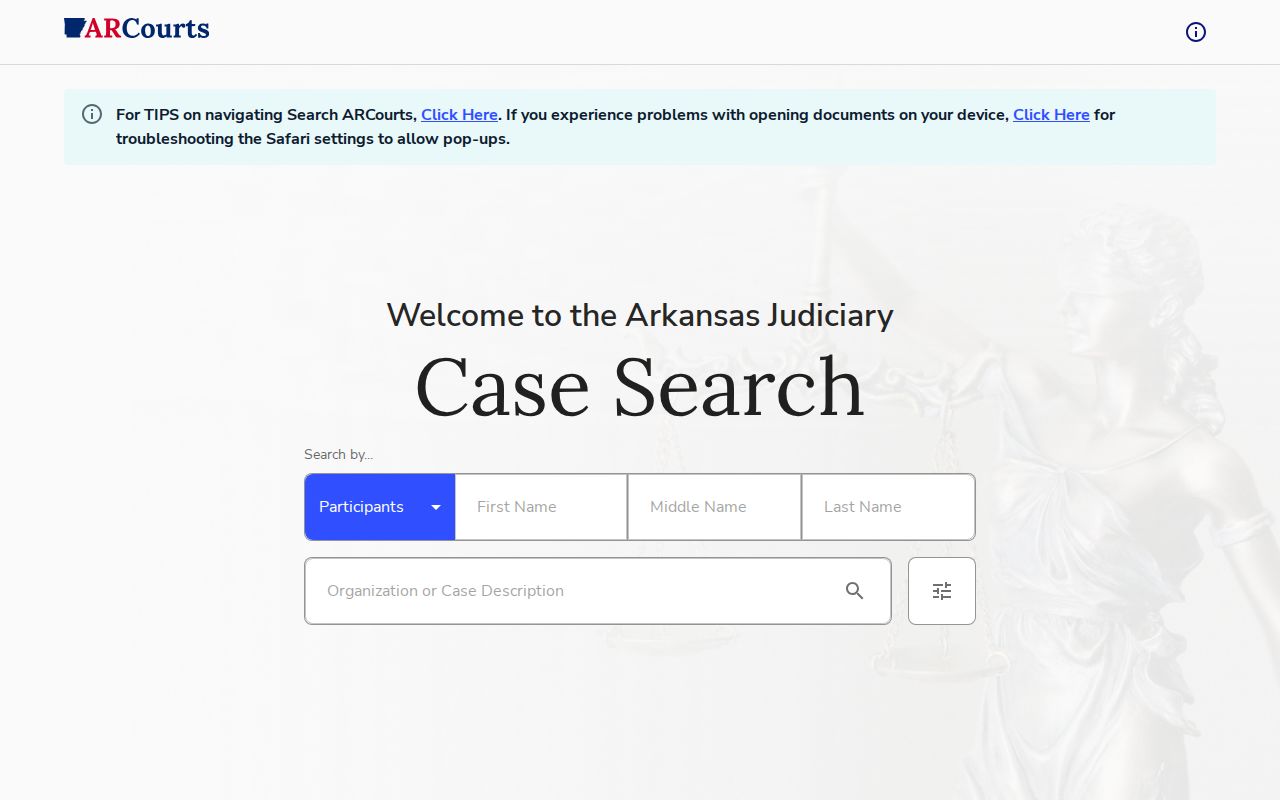
Search ARCourts is Arkansas's statewide participant and case starting point. The courts launched its first release in January 2024 to replace CourtConnect. Search by participant name, organization or case description, case number or citation number. Court participation, historic data and documents vary, so it is an index, not a promise that every local file is online.
| Control | How It Narrows a Search |
|---|---|
| First, Middle, Last Name | Participant search; one or two characters act as exact search, while three or more allow exact or partial matching. A one-character middle name can include an initial. |
| Organization or Case Description | Searches an organization name or a case description. |
| Case Number / Citation Number | Looks for an exact identifier when it is known. |
| Start Date / End Date | Narrows by a date range. |
| Case Type / Docket Code | Optional filters; the full live lists were not captured in the research. |
| County / Court Location | Restricts results to a local court or place. |
| Search / Clear and result filters | Runs or resets the form; results include Contains/Is filters and a filing-date calendar. |
The official Search ARCourts participant and case search is shown here; its controls help narrow a name, but a hit still needs a separate identity check.
A typical public result uses this field set:
| Result Field | What It Shows |
|---|---|
| Name and Party Type | Participant identity and role shown in the case |
| Case ID and Case Description | Case identifier and short case style or description |
| Filing Date, Case Type and Status | When the case was filed, its type and current listed status |
| Case detail | Court, filing type, security or exception, trial type and docket events may appear |
| Document links | Selected public documents, when the court and record allow online access |
The local clerk holds complete files and certified copies, and public display varies by court and security level. Modernization has moved in stages: the courts reported the first MMR-1 deployment by the end of 2025. An April 2026 Rogers beta showed new criminal and traffic functions, with another MMR then targeted for the third quarter of 2026. A beta and target are not proof of a complete statewide public search; check the court and clerk for the record needed.
Verifying Arkansas Resident Records
A matching name is a lead, not an identity. Court parties can share common names, and one person may appear under an initial, married or maiden name, alternate surname order or business entity. A case can list a lawyer or company; a license may show a work address. Keep the county, source date and record number with each result.
For one resident lookup, build a short comparison from independent facts instead of relying on the name alone:
- Write down full name variants and the Arkansas county or approximate year tied to the question.
- Compare an assessor result by parcel, situs and mailing address, while keeping owner separate from occupant.
- Search court name variants with county, date and case-type filters; compare Party Type, filing date and case status.
- Check a second independent source, such as a deed, probate record, business filing, license number or historical directory.
- Ask the custodian for an authorized copy or correction when the public index leaves a material mismatch.
- Docket
- A court's record of case events and filings; it may be shorter than the full case file.
- Index and image
- An index points to a record and summarizes fields. An image is a view of a document, when the custodian makes it available.
- Certified copy
- A copy the custodian authenticates as an official record, often needed when proof of the record itself matters.
A negative result is not proof that someone is absent from Arkansas. A person may use a different name, may not own property, may be protected from display, or may appear only in a local paper file.
Vital Records in an Arkansas Resident Lookup
The Arkansas Department of Health (ADH) is the central issuer of certified birth, death, marriage and divorce records. A certificate is not an open name index. Recent records are restricted to authorized applicants, and the application asks for event details, relationship or reason, identification and delivery details.
| Record | Access Rule | Where to Continue |
|---|---|---|
| Birth | Under 20 CAR §1-1501, after 100 years in state custody it is available to anyone with sufficient locating information, subject to the rule; pre-February 1, 1914 records are limited. | ADH Vital Records; Archives and local sources for historical gaps |
| Death, marriage, divorce and related records | Under 20 CAR §1-1501, after 50 years in state custody they are available under the rule; authorized access applies before that period. | ADH; county clerk for older marriage books; court clerk for divorce pleadings |
ADH offers online, mail and walk-in ordering, with phone and email support; local health units provide some death-record service. A divorce certificate and court case file are different records, and pleadings remain with the court custodian. The Arkansas State Archives, county Archives, library microfilm, cemetery books and newspapers can help with older events or gaps, but digitization is incomplete.
For a family connection, identify the event and likely county before applying. If you are not eligible for a recent certificate, use open historical sources or ask ADH which authorization applies; an index is not a substitute for a restricted copy.
Arkansas Voter Records and Lookup Limits
VoterView, maintained by the Secretary of State, confirms registration status, polling place and sample ballot. It is a limited public lookup, not a street roster. The live form fields were not captured, so do not assume it searches by every address detail or exposes every field held by election officials.
The broader voter file has a separate request process. The Secretary of State form distinguishes these products:
| Request | What It Contains | Important Limit |
|---|---|---|
| VR | Statewide voter ID, county, name, residential and/or mailing address, phone, date of birth, precinct, district, party if applicable and date last voted | Controlled request; not the same as the public VoterView screen |
| VH | Federal election history from 2008 to current, linked to voter ID | Does not include names |
| VRVH | Combined registration and history files linked through voter ID | Use the official request form and stated delivery process |
The Secretary of State request form asks for contact details and file choice. The inspected policy lists $2.50 per file, with possible government waivers, and controlled delivery such as Dropbox. The application, VoterView and released files are separate records; vote history does not reveal ballot choice.
Arkansas Records for Heirs and Classmates
Different personal questions lead to different record trails. For an estate, start with the probate index and then compare the will or administration record, obituary, cemetery entry and deed chain. Public filings may name heirs or an administrator, but protected and sealed details are not assumed public. A recorded release or property transfer can add context without proving a family relationship by itself.
For a former classmate, use the known school and year to search library yearbooks, vertical files, newspapers and city directories. The Fayetteville Public Library Grace Keith collection has local-history material; the Library of Congress and FamilySearch have other directory runs. Match the collection year and place; an old entry is not a current address.
Public affiliations offer another narrow check. Arkansas Secretary of State Business and Commercial Services filings can link a person to an entity or registered-agent role. The Department of Labor and Licensing roster covers many agencies; medical, nursing, bar and other boards use separate tools. A registered-agent or license address is not proof of residence.
Records Requests for an Arkansas Resident Lookup
When an online search stops, ask the office that keeps the record. Arkansas's Freedom of Information Act, Ark. Code §25-19-101 et seq., lets Arkansas citizens inspect or copy public records during regular business hours, subject to exemptions. Name the office, record type, identifier, county and date range. FOIA does not require an agency to create a list it does not keep.
Requests may be made in person, by phone, mail, fax, email or electronic submission. Inspection normally has no fee; a custodian may charge actual reproduction and mailing costs, and a projected charge above $25 may be collected in advance. There is no single numeric response deadline for every request in the reviewed handbook. Ask the custodian about the available format and whether a certified copy must be ordered through a separate process.
For court material, contact the circuit or district clerk about local files, archived cases and certification. For property or deed questions, use the county assessor and circuit clerk, by phone or in person if the index has a gap. ADH accepts vital-record requests through its ordering channels. The State Archives offers research, email copies and microfilm; libraries may hold yearbooks, newspapers and directories. Note the office, request date and coverage cutoff.
Privacy in an Arkansas Resident Lookup
Arkansas has no statewide Safe at Home address-confidentiality program identified in the inspected sources. That does not mean every address is open. Protected voters, sealed and expunged cases, juvenile and adoption material, vital records, and federal driver information have separate limits. Remote court pages may redact details even when an index is public.
There is no general consumer deletion right that erases the underlying county or state record. Correct an error at its source: ask the assessor about a tax-card field, the Secretary of State or election office about a voter entry, the court clerk about a docket, ADH about a vital record, or the relevant agency about a license or business filing. Keep the original record date and ask what form or proof is needed to amend it. A correction to one source does not update unrelated indexes.
Lawful use. Public access does not authorize stalking, threats or repeated unwanted contact. Arkansas Code §5-71-229 and Act 832 of 2025 cover stalking conduct, including acts separated by at least 36 hours within one year.
Use a resident lookup for lawful personal, family-history or civic research. If a detail appears wrong or sensitive, ask its custodian rather than spreading a weak match or seeking a protected address.