
Arkansas Previous Residents by Era
Arkansas has no one statewide address history index. The useful records are held by different county offices, libraries, and archives, and each source covers a different part of a household's story. Washington County provides an inspected example: its online land index reaches back to 1834 and ends at 1991, while city directories, criss-cross books, census schedules, probate, maps, and municipal files fill other years. The table separates verified coverage from sources whose online date range was not established.
| Source | Verified years or range | Where held | What it can show |
|---|---|---|---|
| Washington County deed index | 1834-1991 online; continuation not verified online | Chronicle index and Washington County Archives | Grantor, grantee, document type, book and page |
| Washington County archive books | Land 1834-1991; marriage 1845-1941; 1908 plat book; 1919 voter records | Washington County Archives | Original indexes, plats, and county context |
| Fayetteville and Little Rock directories | Selected Fayetteville years 1939-1957; scattered Little Rock years from 1871, with a 1962 sample | SLCL, LOC, local libraries | Listed names, addresses, and household details |
| Northwest Arkansas criss-cross | 1937 and 1970-1993 | LOC guide, libraries, or microfilm | Reverse search from address to listed name |
| Census schedules | Fayetteville Library microfilm lists 1830-1940; release after 72 years | Library, Archives, and indexed collections | Household at a census date and place |
| Little Rock permit search | Coverage dates not located | City portal and local custodian | Applicant, address, parcel, project, or permit clues |
| Sanborn maps | City and edition years must be checked | LOC and Arkansas Digital Archives | Building footprint and street context, not residents |
For ownership, begin with the deed index and its legal description. For someone listed at a street number, look for a criss-cross or city-directory year. For a whole family, pair an available directory with a released census schedule, then use probate, a newspaper, or cemetery records to test a move or death. Each row is a lead to a holding, not a promise that every year or image is online.
Washington County Deed Chain for Past Residents
Washington County's Chronicle land index is a concrete Arkansas example of a deed chain. The online index covers 1834-1991 and offers document type, sort, full search, book, page range, and Grantor or Grantee search modes, with last-name and first-name fields. It is a convenience index, not a complete statewide deed-image service. Original handwritten indexes are held at the county Archives, and current online coverage after 1991 was not verified. Begin with the parcel's legal description or the current owner's deed reference when available.
Use the seller's name as well as the buyer's. One transfer may be indexed under a business, trust, estate, initials, or a different spelling. Keep the book and page, document type, recording date, legal description, and each name as it appears. Search the name in both index directions when needed; do not treat a mortgage, lien, or release as a change of owner.
- Use the county assessor or parcel map to note the ParcelId, current owner field, situs address, and legal description; the Washington County Assessor is one local example, while other counties have their own cards.
- Search the owner as grantee to locate the deed that transferred the parcel to that owner.
- Read the seller or grantor on that deed, then search that name as grantee for the earlier acquisition.
- Repeat backward, recording the legal description and book/page each time; try spelling and name-order variants.
- When the online range ends or an image is missing, ask the clerk or Archives about books, microfilm, or a copy.
- Grantor / grantee
- The grantor gives or transfers the interest; the grantee receives it.
- Chain of title
- The linked record of ownership transfers for a parcel over time.
- Legal description
- The lot, block, subdivision, or section-based wording that identifies land even when a street name or number changes.
The Washington County index shown below is the online route. For an in-person question, the Circuit Clerk's recording counter is at 280 N College, Suite 302, Fayetteville, and the listed phone is 479-444-1538.
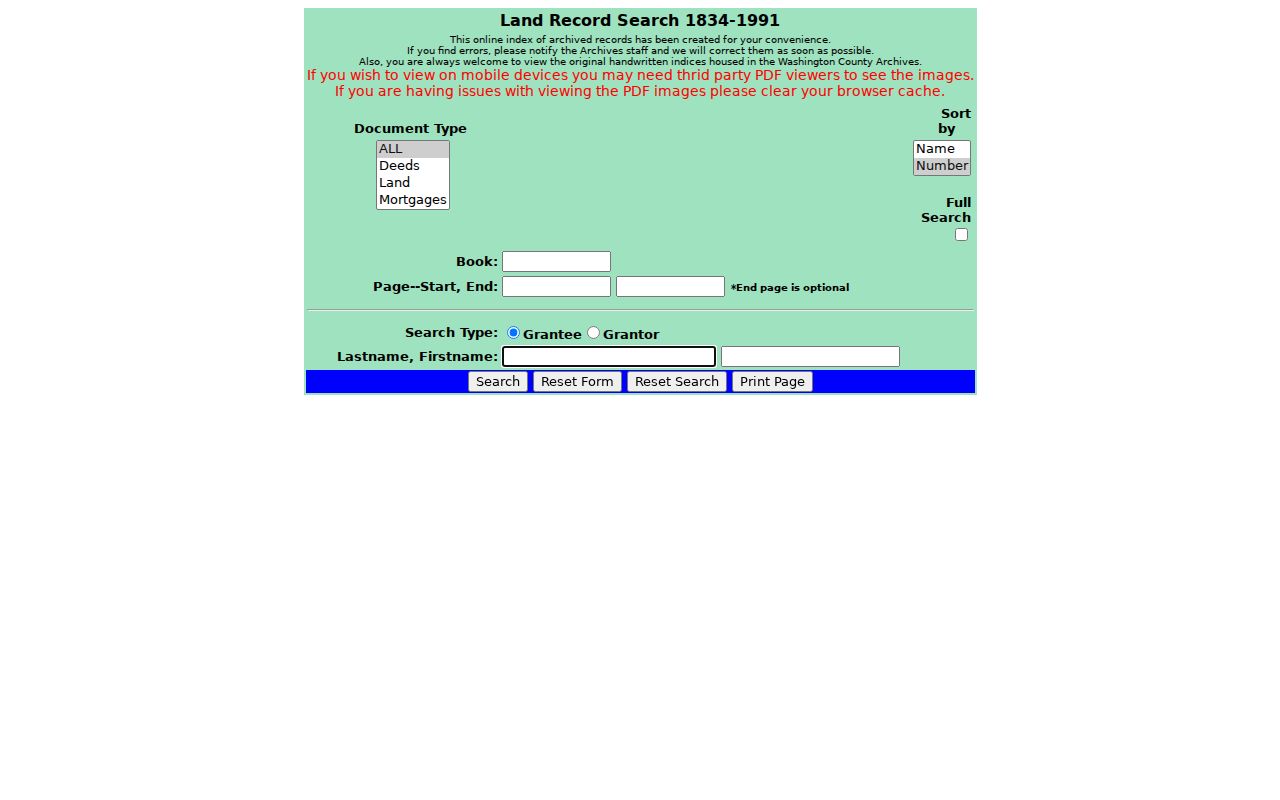
A result gives a path to the recorded instrument; the clerk or archive can explain whether a copy, older book, or later index is available.
Arkansas Previous Resident Records After the 1991 Index
The Washington County cutoff creates two different research tasks. For a transfer indexed from 1834 through 1991, search the Chronicle by party name or book and page. For an older handwritten reference, or a document after the displayed range, ask the Circuit Clerk which current books or local indexes cover the date. Research notes did not verify the later online range, image access, download options, or fees, so those details should be confirmed with the custodian instead of assumed.
Washington County Archives holds original indexes and local record groups, including land, marriage, court, tax, school, and voter material. Its collection page lists an address at 4 S College Avenue in Fayetteville and a Wednesday research window from 9 a.m. to 3 p.m., closed from noon to 1 p.m.; call 479-444-1543 before traveling. The archives are an in-person fallback for books that a web search cannot reach. For a certified or mailed copy, ask the clerk about the request steps and current copy fee.
County coverage varies across Arkansas. The Arkansas county services directory can route a researcher to the proper assessor or clerk, but it is not a single statewide deed index. For records held by a public office, an Arkansas Freedom of Information Act request may be made in person, by phone, mail, fax, email, or electronic submission, subject to exemptions and reproduction costs.
Directory Years for Past Arkansas Residents
Historical directories add names to a deed trail, but the collections vary by town. Fayetteville has verified editions for 1939, 1947, 1951, 1955, and 1957. Little Rock has scattered city books from the 1870s through later decades, plus combined Little Rock/North Little Rock volumes. The LOC guide to criss-cross holdings lists Northwest Arkansas years for 1937 and 1970-1993. These runs can help place an owner or relative at an address, but they do not establish that a person owned the parcel or remained there all year.
Use the Arkansas city directory collections page for the publisher and holding details. Here, the useful task is to compare each available year with the deed date: search an address in a reverse directory when the name is unknown, then check the alphabetical name section. Keep the directory's city abbreviation and street wording; Little Rock shorthand such as LR or NLR, directionals, and shortened avenue or road names can affect a match.
If the address does not match the current street number, compare the block, lot, neighboring streets, and year. A result should remain labeled as a historical listing until another record supports the connection.
Pair Arkansas Directory and Census Years for Past Residents
A census and a directory answer different questions. The census records a household at a particular enumeration date; a directory may list a name and street for a nearby year. Fayetteville Public Library lists census microfilm from 1830-1940, and federal schedules become public after a 72-year release period. Census pages follow their own enumeration order rather than a modern street-name index, so compare the district, page, and nearby households when that detail is available.
- Choose the directory year closest to the deed, probate, or known family event.
- Search the name and address in that edition, writing down the volume, page, and printed spelling.
- Compare the nearest released census household, using ages and family links as historical checks.
- Check a second directory or a newspaper notice before deciding that a person moved or died.
- Save the census and directory citations separately; each one supports only its own date and fields.
Fayetteville's Grace Keith Genealogy Collection brings these sources together with county books, maps, yearbooks, newspapers, microfilm readers, onsite licensed databases, and an obituary database. It also covers Washington County probate from 1830, court from 1835, land from 1834, marriage from 1845, and birth and death from 1914. The genealogy desk lists 479-856-7253 and genealogy@faylib.org for collection questions; ask staff about a specific reel or county start date when the catalog does not settle whether an item survives.
The Grace Keith collection and research-service page describes the local genealogy shelves and contact route. The image below marks the Fayetteville library as a place to check the records that have not been digitized.

Library staff can point to the right reel, county book, or obituary resource and explain whether an onsite database or research request is needed.
Arkansas Resident Households in Census and Obituaries
Directories and census schedules may point to a household, while probate and obituaries can explain what happened when a family left an address. Washington County probate records begin in 1830 in Fayetteville Public Library's county guide; the guide dates marriage records to 1845 and court records to 1835. Wills, administrators, and heir references can connect a property transfer to relatives. Search the county clerk or Archives for the record itself, and use Search ARCourts only as an index where a public court record is available.
Newspapers may fill a year between directory editions. LOC's Arkansas Gazette holdings list Little Rock newspaper material from 1889-1991; Fayetteville Library also has local newspaper runs, obituary resources, and microfilm. Little Rock City Clerk records include Oakland and Fraternal Cemetery Record Books and cemetery deeds. These are local sources, not a statewide cemetery index. A cemetery or obituary clue can help identify a family link, but it does not prove which person occupied a given home.
Lawful personal use. Use older address records for family and house history, genealogy, or civic research. Do not use a record trail to harass or pressure a living person.
Arkansas Address Records and Old Plats
An address may change while the parcel stays in place. Washington County's 911 address application ties an assignment to parcel, subdivision or lot, and map or survey details. Annexation, a renamed street, directional suffixes, rural-route conventions, and later readdressing can all make a historic listing look unrelated to a current one. Compare the legal description, lot and block, nearby street names, and parcel shape before treating two address strings as different properties. Little Rock's original 1822 plat is a useful bridge to early street names and blocks; it does not identify a later resident by itself.
The Arkansas Digital Archives image of the original Little Rock plat was filed on February 2, 1822. The map shown below can help place an early block or street name in its historic layout. Check the map title, date, and sheet along with any modern parcel reference.
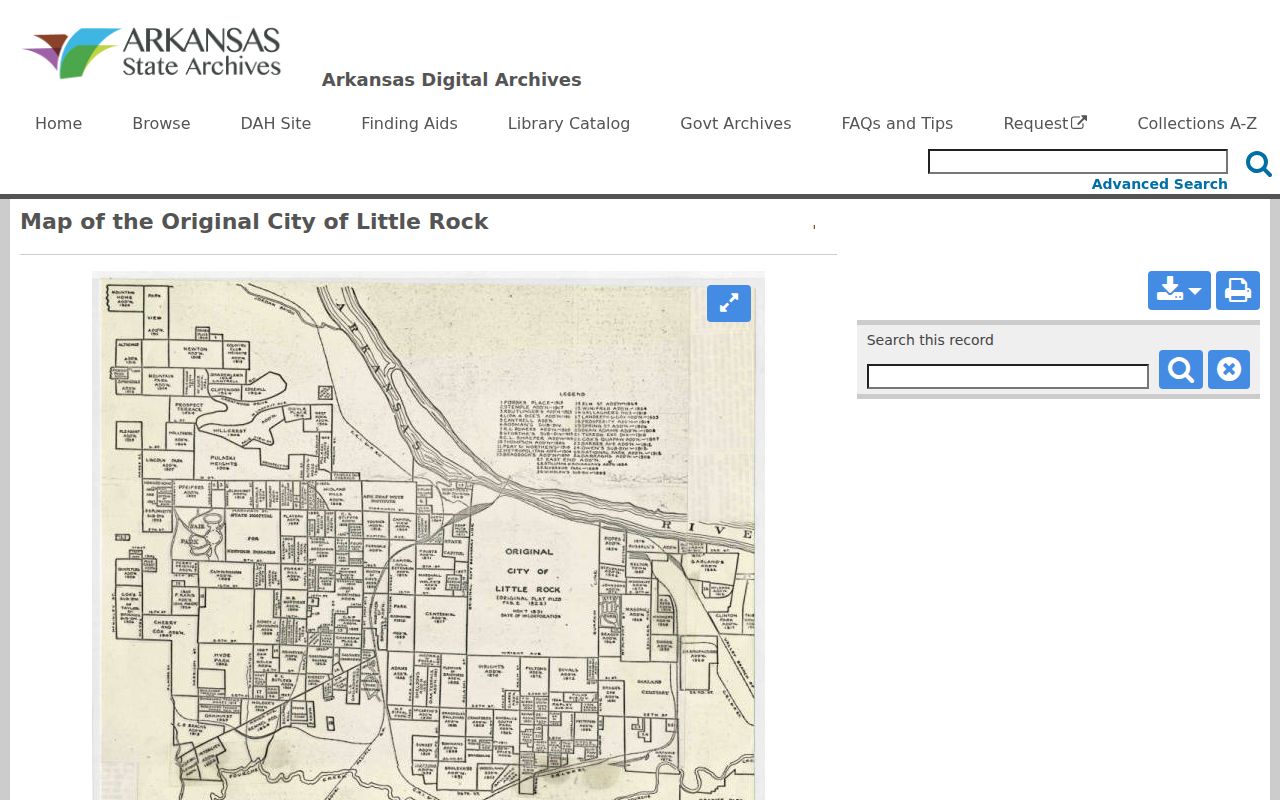
A map helps explain a street or parcel location; it is not a deed, survey, or resident list. The Library of Congress Arkansas local-history guide and the Digital Archives have map collections, but exact Sanborn years for a particular Arkansas city must be checked edition by edition. Do not infer a construction year or occupant from the map alone.
When Arkansas County Books Are Missing
Record loss is part of Arkansas house history. The Arkansas State Archives reports that about 40 of 75 counties experienced courthouse fires, tornadoes, or floods that damaged or destroyed early records. Its microfilm holdings include marriage, probate, tax, land, and court material from all 75 counties. Staff can search by title, name, county, or date; email requests can ask for a scan or photocopy, with the Archives setting the page count and price. Payment is by check, money order, or cash, and the research rooms provide an in-person route when a remote search is not enough.
When a deed volume or directory year is absent, look for a second copy, tax entry, probate file, newspaper notice, church record, cemetery book, or manuscript collection. Unusual Arkansas census substitutes include the 1829 statewide Sheriff's Census, the 1865 Washington County census, and the 1887 Newport census. They will not answer every address question, but they can add a household or place reference in years without a matching federal schedule.
Keep a worksheet with one row per source: date, address as printed, person or entity, record type, volume/page, legal description, and whether the item is an index, image, transcription, or finding aid. That record of the search makes gaps visible and keeps an uncertain match from turning into a firm claim.